Skip to content
outpace.
Video · Working with agents

Harness Engineering: 4 Levers to Diagnose Any AI Agent

Damian Galarza on why most agent failures come from the system around the model, and four questions for finding which part broke.

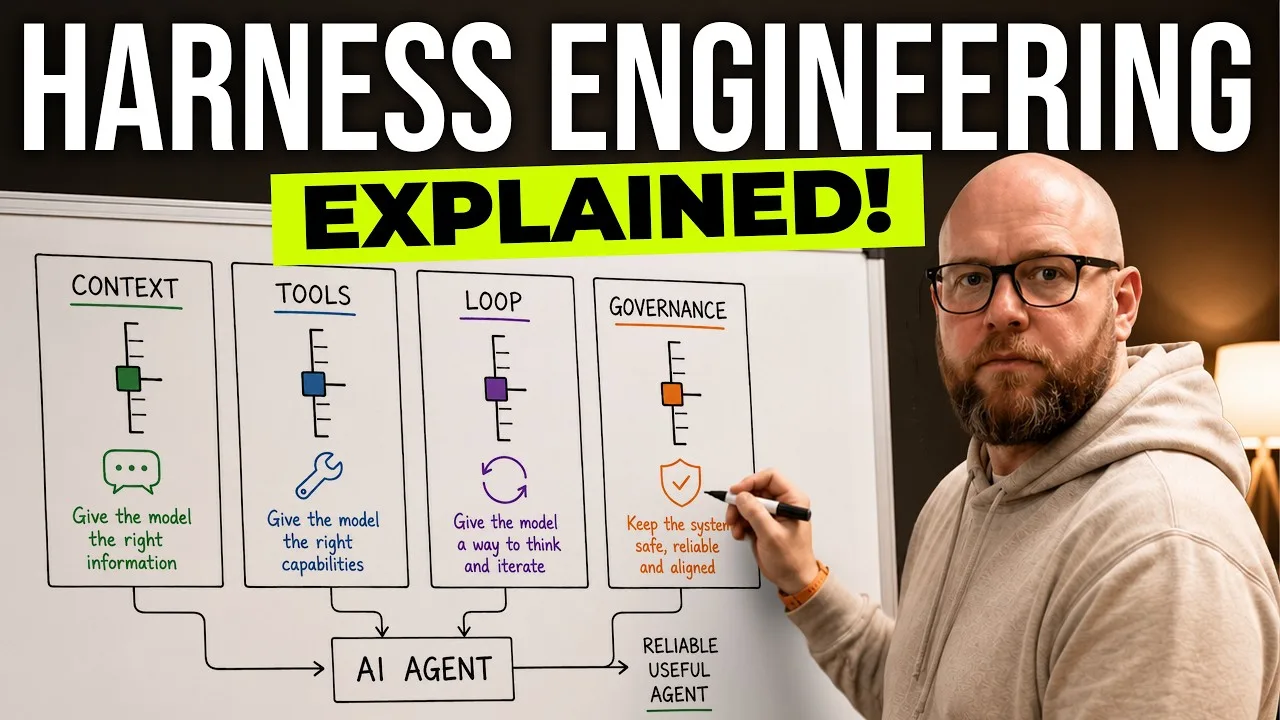
Damian Galarza at a whiteboard showing four sliders labelled context, tools, loop and governance, feeding into an AI agent, under the words "Harness Engineering Explained!"Watch on YouTube ↗ (opens in a new tab)

Damian Galarza separates three things that often all get called agents: a single model call, a workflow where code sets the path, and an agent, where the model chooses its own next step. Once the model owns part of the path, the system around it matters most. He calls that system the harness and splits it into four levers: context, tools, the loop and governance. His examples are plain: drafting an email is different from sending it, and suggesting a budget change is different from making it.

When an agent gets something wrong, the easy thing is to blame the model and wait for a better one. Galarza shows why that rarely fixes it. A strong model in a poorly set up system still misses instructions, reaches for the wrong tool and does things nobody asked for.

It's how I approached the assistant in our own CRM: decide what it can see, what it can do and where a person steps in, before worrying about the model. It only sees what the person asking is allowed to see. It can draft a campaign, but it can't send one. And I tested everything it's meant to do before relying on it.

If you're running an agent, or about to buy one, try writing three lists: what it does on its own, what needs a person to approve, and what it must never do. If you can't fill them in yet, that's where I'd start.

Highlights

  • When an agent fails, ask which lever broke: what it could see, what it could do, how it kept going, or what it was allowed to do.
  • More context isn't automatically better. The right information has to be there, in the right shape, at the moment the model decides.
  • Decide up front which actions run on their own, which need approval, and which are off limits.

From the transcript

The model sets the ceiling, but the harness determines how much of that capability you actually get to use.

AgentsGovernance

Continue reading

All articles →
A white-haired man in a black and white striped suit surfing a board across a wave of glowing green code.

Onboarding an AI Teammate: The First Five Days

In January 2026 we gave an AI agent a name, a seat and a job at Orion Group. This is what the first five days actually looked like, broken permissions included.

Teresa Torres and Peter Yang either side of a mocked-up post reading "Claude Code runs my life"49:37

Build Your Personal OS with Claude Code

Teresa Torres shows her actual week with an agent: the daily list, the writing she won't hand over, and the notes that stop her repeating herself.

Illustration of a man sitting on a chair on top of a red block beside a small speaker, its cable trailing into blue water, against a flat red background.

Amplified: How AI Shortens Time

AI turns small signals into fast shifts. How to spot the early friction, pace your response, and place changes where they stick.